
by Laura K. Secor
Hello my UUCW friends,
Last month I introduced you to the T’ang dynasty poets of China, who wrote from within the Ch’an tradition, a mix of Taoism and Buddhism that would eventually give rise to Japanese Zen. We explored the challenges the Anglophone world faced when first encountering these poets. It took time for us to find our way to an expression that contained the simplicity and weightlessness of these short, ancient poems. Now, a century after Ezra Pound, many wonderful translators offer us these poets as though unspooling a spare, elegant thread. David Young, a wonderful poet in his own right, brings us his Li Po:
A Clear Wet Dawn by Li Po (trans. David Young)
Cool fields
the thin rain
stops
spring in every direction
blue pond
swarms with fish
thrushes sing
in the green branches
flowers look tear-streaked
grass in high meadows
bends level
through the bamboo in the still stream
you can see
the last shreds of cloud
scattering
in the dawn wind
If you are familiar with the imagist poets, you can see their inspiration here. Think of William Carlos Williams’ red wheelbarrow. And like Williams, these poets are doing more than painting a picture. Like Williams, they are offering a world-view, but theirs is steeped in the philosophies of Lao Tzu and Siddhartha Gautama, and not much like our Western preference for ideas, for this thing pointing to that thing. The world-view of the T’ang poets aspires to live only in the present moment. We often spend our lives caught in the past or anticipating the future. But the real magic happens in the present moment, which is easiest to find far from the city, perhaps in a little boat floating on a bamboo-edged stream, watching for the little fish circling in the eddies.
Perhaps you will indulge me in one more “moment”? Also translated by David Young.
Floating on a Marsh by Wang Wei (trans. David Young)
Autumn
the sky huge and clear
the marsh miles from farms and houses
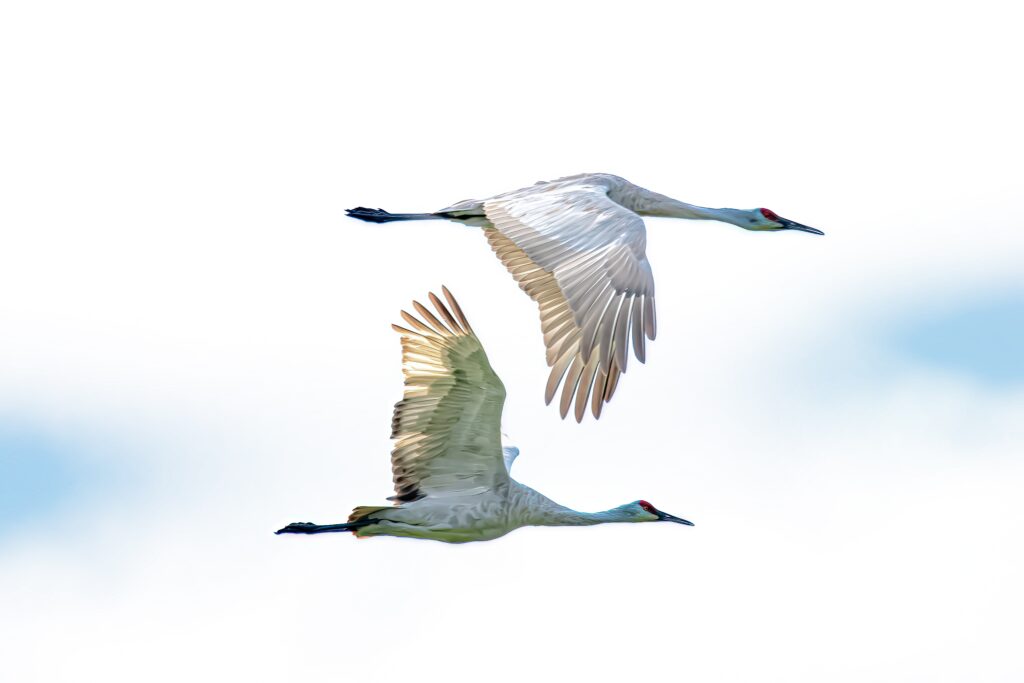
overjoyed by the cranes
standing around the sandbar
the mountains above the clouds in the distance
this water
utterly still
in the dusk
the white moon overhead
I left my boat drift free tonight
I can’t go home
I admit, I think I could find the peace of the present moment much more easily if I were in a little boat watching the cranes on their sandbar under the moonlight. If I write – gosh, I can’t remember the last time I was in my little boat, watching the cranes beneath the full moon – you’ll know I’ve never actually been there, right? I suddenly think I should make a priority of getting out onto a lake at sunset when the moon is rising…. I know a lake where a family of loons are sure to make an appearance…
Last month, I mentioned the contemporary American poet Jane Hirshfield. She is in dialogue with the T’ang poets, but is also exploring the philosophy they lived through a modern lens. She talks about modern strategies for surviving, even thriving, under the vast uncertainties of the world. First I will give you her elegant words on the dilemma itself:
“One of the penalties and graces of consciousness is waking each day to the awareness that the future cannot be predicted, that the universe’s foundation rests on an incomprehensible receding, that bewilderment, caprice, and the unknowable are among the most faithful companions of any life.”
And what are the strategies? We all know the first strategy – distraction. And sometimes, particularly when wakeful at 3 am, we know the second strategy – staring into the void and saying, what will be, will be. A form of acceptance doing the cha cha with fatalism. But the strategy of the T’ang poets, which Jane aspires to, is the “faithful reporting of only that which is present…. Our sense of the experienced real, which is equally wavering, fragile, and subject to changes of wind.”
I believe the two poems above manage to limit themselves to faithful reporting of the real, while at the same time allowing the real to be wavering, fragile and wind-blown.
I believe that Jane herself does something different, yet equally wonderful. She states her desire to write as Li Po and Wang Wei wrote. She talks of “the slowed and deepened breath that comes with the release of fixed ideas for the more complex fullness and air of the real.” A lovely desire to release the ideas. However, her own poetry cannot resist the lure of ideas. Each thing which is present in the moment, present in the poem, stands for some other thing, something unreal, much as did Williams’ wheelbarrow. I believe the poem below is a fantastical mix of the real and the ideal, and each informs the other in a complex dance.
Lake and Maple by Jane Hirshfield
I want to give myself
utterly
as this maple
that burned and burned
for three days without stinting
and then in two more
dropped off every leaf;
as this lake that,
no matter what comes
to its green-blue depths,
both takes and returns it.
In the still heart,
that refuses nothing,
the world is twice-born—
two earths wheeling,
two heavens,
two egrets reaching
down into subtraction;
even the fish
for an instant doubled,
before it is gone.
I want the fish.
I want the losing it all
when it rains and I want
the returning transparence.
I want the place
by the edge-flowers where
the shallow sand is deceptive,
where whatever
steps in must plunge,
and I want the ones
who come in secret to drink
only in early darkness,
and I want the ones
who are swallowed.
I want the way
the water sees without eyes,
hears without ears,
shivers without will or fear
at the gentlest touch.
I want it the way it
accepts the cold moonlight
and lets it pass,
the way it lets
all of it pass
without judgment or comment.
There is a lake,
Lalla Ded sang, no larger
than one seed of mustard,
that all things return to.
O heart, if you
will not, cannot, give me the lake,
then give me the song.
Can you choose a favorite couplet? Today I choose “I want the losing it all / when it rains.” On another day, I might be moved to choose “shivers without will or fear / at the gentlest touch.” Someone else might have chosen, “In the still heart / that refuses nothing.” What image catches on your heart?