
by Laura K. Secor
Hello my friends,
We are picking up our discussion of Shantideva’s 8th century text on Buddhism, called The Way of the Bodhisattva. In this book, the sage discusses ways to be the kind of Buddhist who aspires to reach inner peace in order to help other people. I believe Thich Nhat Hanh was such a Bodhisattva.
Both Shantideva and Thich Nhat Hanh believe that every one of us have it inside us to become a Bodhisattva, if we choose the way and work diligently at the precepts. Chapter 5 of the Way of the Bodhisattva is often considered the pivotal chapter, and here I give you the opening of the chapter, as presented and explained by our dear friend Pema. Next week we will discuss how these ideas my apply in our ordinary and not-so-ordinary lives.
The following is an excerpt from Pema Chodron’s book, “No Time to Lose”
In CHAPTER 5 of The Way of the Bodhisattva, Shantideva gives instruction on the paramita of discipline. The theme of discipline generally emphasizes conduct, the way we speak and act. The main theme here, however, is taming the mind. In order for any outer discipline to transform us—and for bodhichitta to not diminish—it’s essential to tame the wildness of our minds.
5.1 Those who wish to keep a rule of life
Must guard their minds in perfect self-possession.
Without this guard upon the mind,
No discipline can ever be maintained.
The method for taming the mind is shamatha meditation.Shamatha is a Sanskrit word meaning “calm abiding,” or “the development of peace.” In this practice, we generally work with the breath as our object of meditation. But whatever object we use, the instruction is always the same: when we see that our mind is wandering, we gently bring it back. In this way, we come back to the present, back to the immediacy of our experience. This is done without harshness or judgment, and it’s done over and over again.
When the mind is wild, we have no foundation for maintaining discipline: specifically, the three disciplines of not causing harm, gathering virtue, and benefiting others.
How can we work with the kleshas, or act and speak with kindness, or reach out to others, if our mind is crazed? Without the stability and alertness of a tamed mind, how can we be present? Therefore, mindfully, gently, and repeatedly, we train in coming back. Taming the mind takes time. Through good and bad moods, through periods of peacefulness and klesha attacks, we train in being present. Day by day, month by month, year by year, we become better able to keep a rule of life, better able to lead the life of a bodhisattva who can hear the cries of the world and extend a hand.
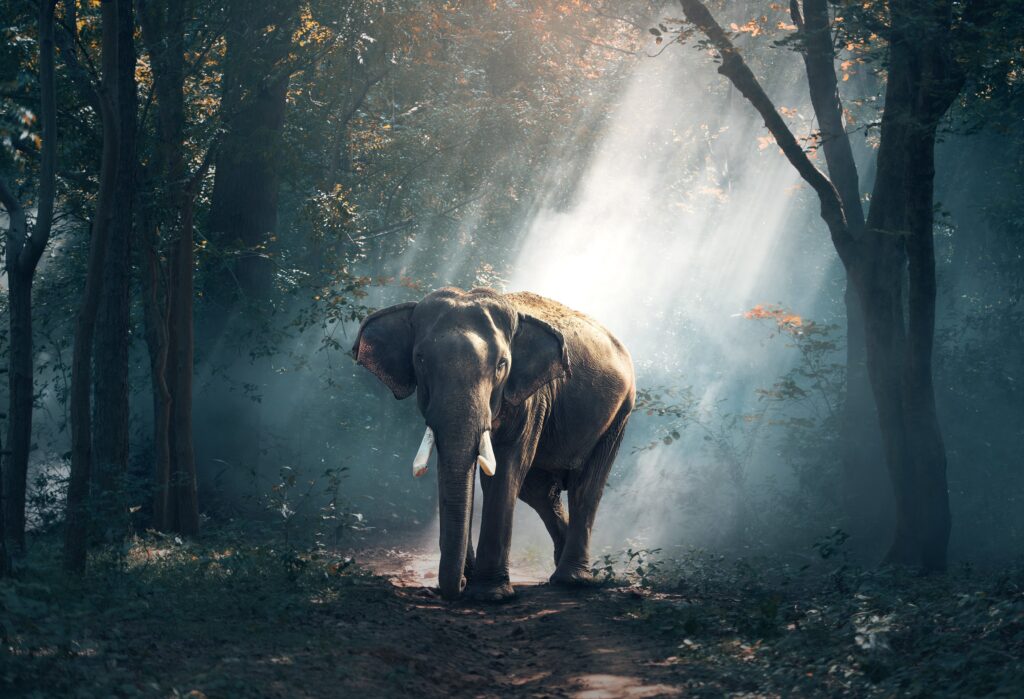
5.2 Wandering where it will, the elephant of mind,
Will bring us down to pains of deepest hell.
No worldly beast, however wild,
Could bring upon us such calamities.
In Buddhist literature there are many animal analogies for the wildness of mind: monkey mind, for example, or the out-of-control nature of an untamed horse. Here Shantideva magnifies the image by choosing the most powerful of all tamable beasts: an elephant. If a wild horse or monkey can wreak havoc, imagine the destruction that could result from a crazed elephant!
If I were delivering verse 2, it might read like this: “If our mind remains untamed and distracted, we will have constant emotional upheavals, and our anger and addictions will get stronger.” But Shantideva is not one to mince words. A scattered mind, he says, will bring us down to pains of deepest hell. Here “hell” is a synonym for the dire consequences of a distracted mind. Shantideva uses bold language to make sure we get this point. Until we start taming the mind, we’re constantly pushed around by our emotions. Nothing in this world—no beasts, muggers, or outer threats—cause us as much unhappiness as our own wild elephant mind.
5.3 If, with mindfulness’ rope,
The elephant of the mind is tethered all around,
Our fears will come to nothing,
Every virtue drop into our hands.