
by Robin Mitzcavitch, Director of Religious Exploration
“Sometimes healing begins not with fixing, but with allowing.”
In the Soul Matters Small Group Discussion materials, there is an exercise that suggests taking pictures of things that are broken but beautiful. I decided to try this as I’m recovering from shoulder surgery, feeling a bit broken myself.
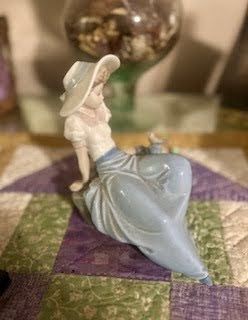
Maybe I have a little problem with getting rid of things that aren’t perfect. Call me sentimental. But, I remember the time my son threw the baseball in the house and broke my mother’s Lladro. I still have it, the arm tentatively glued back on. It was a moment where my son knew that he broke something that was precious to me and there was no undoing what was done. I saw it in his eyes. I forced myself to push down my horror and explain calmly that glue would fix it, and baseballs belong outside.
The Lladro was still beautiful in my eyes.
My mother loved Lladros; the soft blue and cream porcelain, the delicate sculptures, serene in their beauty. I went to Spain on my honeymoon, and bought one for her at quite a great price. I was so thrilled to give it to her. It was a lounging girl with a curly bob, a little hat on her head, and a blue bird in her outstretched hand. My mom did adore it. She said it looked just like me when I was younger. I felt like it was the perfect gift.
When my mom died, I decided that this little Lladro was coming to stay with me, and I felt connected to her whenever I looked at it. I told my kids how special it was when they wanted to pick it up- they understood. So you can imagine the energy in the room, when that very thing was broken.
The group discussion activity asks, after you take photos of “broken yet beautiful” things in your life, to ask yourself some questions.
- How these broken but beautiful things are inviting you to view your life anew.
- How might they be wanting you to understand “brokenness” differently? Or “beauty” differently?
- What message about beauty and pain do they want you to hear?
- What kind of healing might they be offering you?
Yes, we can and should wonder about the brokenness and healing of the self. How are you still beautiful despite the hardship you’ve endured? Is there a way to see an alternate view? Can you use something that once broke in you to help someone through a crisis with added empathy.
With the children last week, the leaders discussed how light heals when there is suffering in the dark places. A single person can heal another by shedding their light of hope and care upon them. Their light can be as simple as a smile, or a kind comment, or time spent beside one who feels broken. This, I feel, is what we are here to do as a community of wanderers…to share the healing, view the areas that have been broken with new eyes, shedding light on the possibilities of repair.
Warmly,
Robin