
by Melissa McKeon, President, UUCW Board of Management
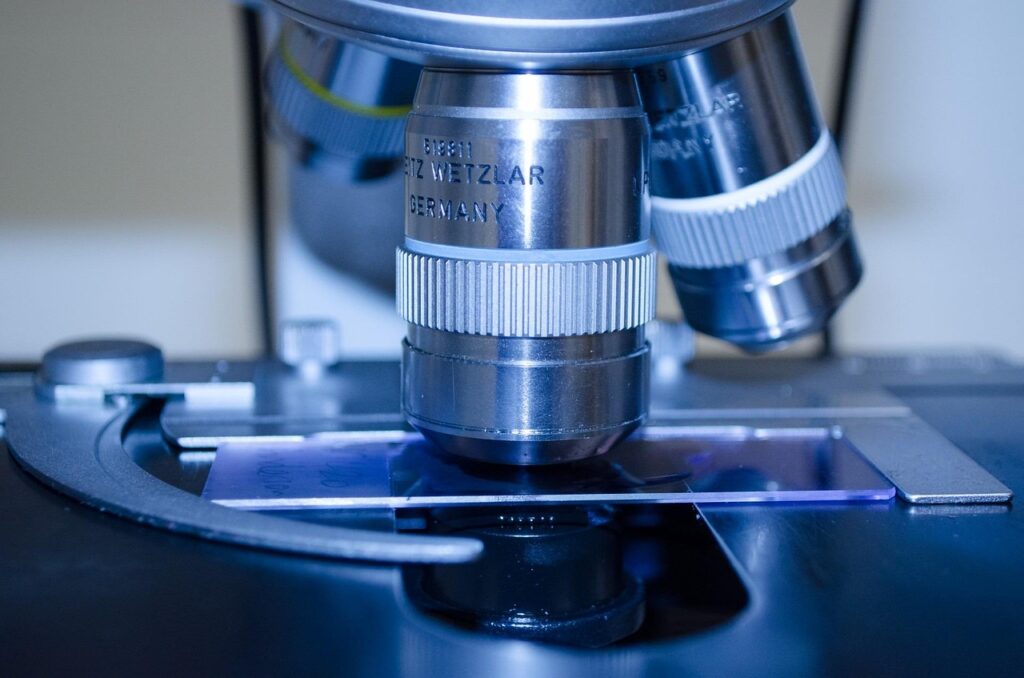
As a humanities person, I’ve spent very little time in my life looking through a microscope, but the first time I did (so long ago I don’t like to admit it), was a revelation: a tiny drop of saliva and cheek cells became the domain of monsters, strange shapes, weird wiggling predators on a little slab of glass. The contrast was profound: my saliva looked simple until you looked very closely, when it became fearsome and strange. (To be clear, I deeply admire the folks who look through the microscope and say, “Cool!” and go on to study what they do and invent things like vaccines. The lessons they took from ninth grade biology are quite different, I’m happy to say. Mine is no less profound.)
I remember nothing about what poor Mr. Mombourquette tried to teach us about cell biology and what we were looking at, but my lesson has stayed with me forever: looking at the big picture was so much simpler, and, by extension, so much easier for a simple human being (read: humanities major) to accept and understand.
But here’s the first corollary: while this was a lesson for me about looking at the big picture to keep from being overwhelmed by the details, it was also clear that we are those little specks on the slide.
This was reinforced, I’m hesitant to say, by religion. Much as I’d like to paint my religious education with a broad brush of negativity, some things about Christianity taught me a similar lesson about that corollary: there was something bigger (which Christianity calls God) and we were just a tiny speck in the cosmos in comparison. The big picture (God) was good, the little picture (humanity) was, well, more complicated.
I have rejected much of what I was taught by my Roman Catholic education, and I like the view that Christianity is a metaphor, a construct to help little human beings understand they’re a small part of the cosmos, or, more cynically, a way to control the populous, to keep them from running out into the night pulling their hair out at the craziness of the world.
That lesson has a corollary, too. If we are only small specks, tiny parts of the big picture, then we have two choices: believe that our small contribution is a responsibility, that we are a part of the whole and therefore valuable big picture we should be keeping our eyes on, or be overwhelmed by that smallness, and do nothing—wiggle helplessly on the slide.
The times we’re living in can easily drive us to do the latter. Like everyone else, I can too easily get sucked into what is now called “doom scrolling,” that is, scrolling through one’s phone or online on news and opinion sources until the weight of the daily bad news adds up and chips away at our peace of mind, becomes all but unbearable—looking too closely at the little monsters on the slide.
That’s when I thank the universe for that ninth-grade biology lesson: concentrate on the big picture and I’ll be less afraid.
When it’s all still becoming overwhelming, I try to remember to take inspiration from my fellow little beings, to do what Mr. Rogers’ mom told him to do: look around for the helpers. In the theory I am trying to live by, they’re the little pieces keeping their eyes on the big picture, that is simpler, easier, better (maybe they’re just operating on a different paradigm, that we may be little people, but we’re responsible for doing good). Either way, they value their place in the bigger picture or know that, no matter how small, they’re an important part, and their object is to do their best and hope for the best and have faith that the mass of doing good will contribute to the big picture’s benevolence.
All of this also, obviously, depends on believing in that benevolence, that the big picture is good, that there’s hope, that our efforts contribute to something good. That “the arc of the moral universe is long, but it bends toward justice,” (if you’ll accept my third mixed metaphor) according to the Unitarian minister Theodore Parker, later quoted by Martin Luther King Jr.
Since I do not always have a deity’s ability to stand far above and only look at the big picture, since I’m a little thing wiggling on the slide, my job, as I view it, is challenging. I need to stop looking down and cling to those others who are doing their best and keeping their eyes on the big picture, the justice of the world, the good we can do. Coming to our church, to work on projects, to attend a meeting with others, to attend a service or just have dinner with others, all remind me, in subtle and not so subtle ways, that Mrs. Rogers was right. The hope lies in looking around the room at all the people around us who are trying, in small and big ways, to do nice things for each other and the world, who are doing the only thing we really can do.
This is just one of the things I do to help keep an eye on the big picture. As a writer, there is another: read what other writers have written about this.
Sometimes I need the lyricism of poets (though I don’t write poetry). The poet Mary Oliver has much to say about living, using the metaphors that work for me, and that, in a way, bring me back to biology: that the sky, the stars, the weather, the flowers, the plants and animals all have some metaphors to help inspire, that we are all part of a kinder big picture that we should keep in mind. This comforts me, makes me simultaneously feel that there’s a bigger picture, and it’s benevolent, and that, no matter how weird we look when we’re under the microscope, we are all an important part of it.
“Love yourself. Then forget it. Then, love the world.” (From, “To begin with, the sweet grass,” by Mary Oliver, in Devotions: The Selected Poems of Mary Oliver.)